


Referenced in this article
Key Takeaways
- 14.3 million Americans aged 12+ misused prescription drugs in 2021 according to SAMHSA, spanning 3 categories: opioids, benzodiazepines, and stimulants
- Prescription opioid addiction treatment uses the same FDA-approved MAT medications as heroin addiction: buprenorphine, naltrexone, and methadone
- Benzodiazepine withdrawal requires medical taper over 4-16 weeks — abrupt cessation causes seizures and is medically dangerous
- Prescription stimulant addiction (Adderall, Ritalin) relies on behavioral therapy, as no FDA-approved medication targets stimulant use disorder
- Ascend Recovery Center treats all 3 categories of prescription drug addiction through PHP, IOP, and outpatient programming
What Are the 3 Categories of Commonly Misused Prescription Drugs?
The 3 categories of commonly misused prescription drugs are opioid analgesics, benzodiazepine sedatives, and amphetamine-type stimulants, each carrying distinct pharmacological profiles, addiction mechanisms, and clinical risks.
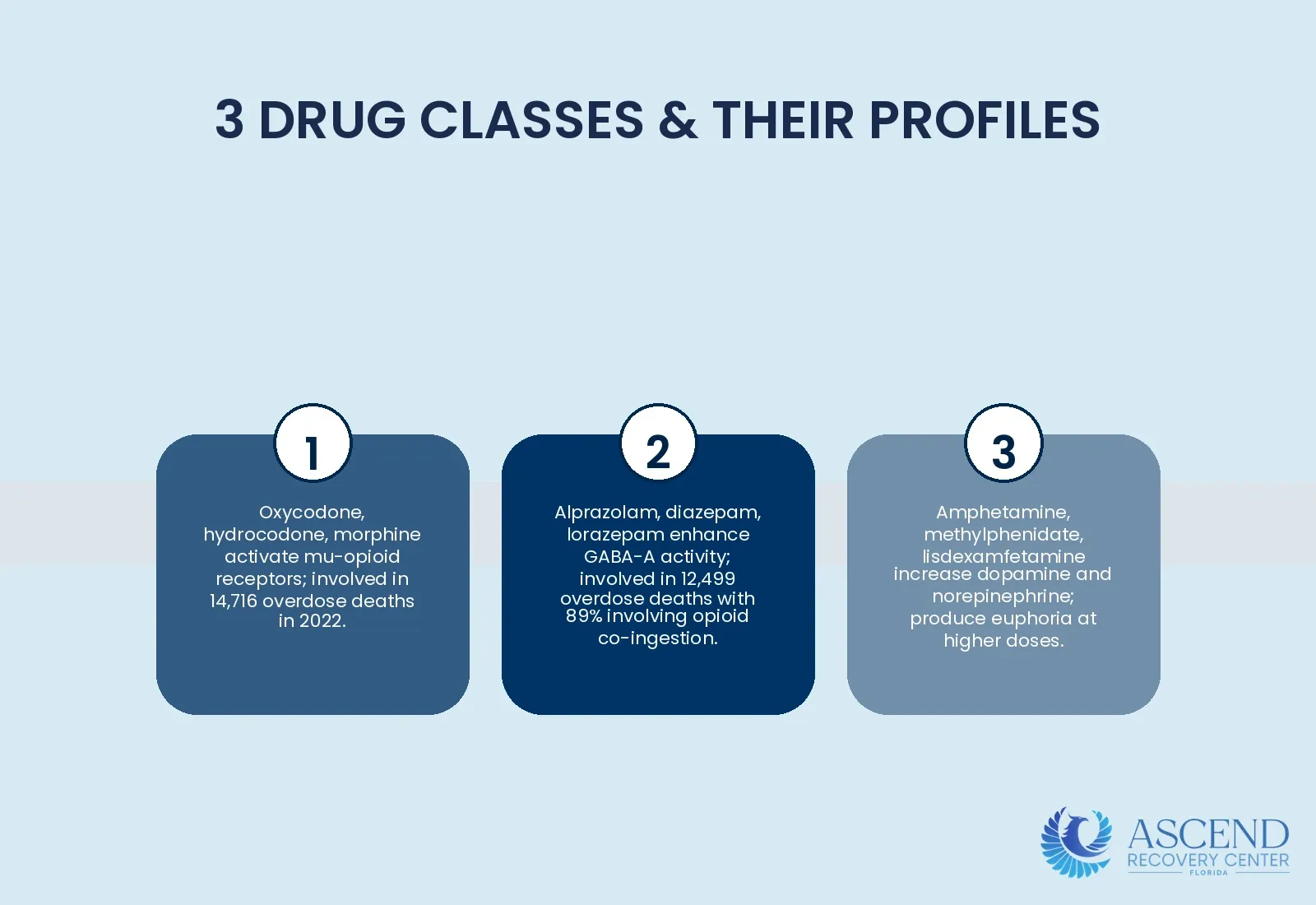
The following are the 3 categories of misused prescription drugs with specific drug names:
- Prescription opioids — oxycodone (OxyContin, Percocet), hydrocodone (Vicodin, Norco), morphine (MS Contin), codeine, fentanyl (Duragesic patches), and tramadol (Ultram). Prescription opioids activate mu-opioid receptors, producing analgesia, euphoria, and physical dependence. Prescription opioid misuse frequently escalates to heroin use when prescription sources become unavailable. According to the CDC, prescription opioids were involved in 14,716 overdose deaths in 2022. Schedule II classification applies to oxycodone, hydrocodone, fentanyl, and morphine.
- Benzodiazepines — alprazolam (Xanax), diazepam (Valium), lorazepam (Ativan), clonazepam (Klonopin), and temazepam (Restoril). Benzodiazepines enhance GABA-A receptor activity, producing anxiolytic, sedative, and muscle-relaxant effects. Benzodiazepines were involved in 12,499 overdose deaths in 2022, with 89% involving co-ingestion of opioids. Schedule IV classification applies to most benzodiazepines.
- Prescription stimulants — amphetamine/dextroamphetamine (Adderall), methylphenidate (Ritalin, Concerta), lisdexamfetamine (Vyvanse), and dextroamphetamine (Dexedrine). Prescription stimulants increase dopamine and norepinephrine activity, improving attention and focus at therapeutic doses while producing euphoria at higher doses. Schedule II classification applies to all prescription amphetamines and methylphenidate.
Each drug class requires a distinct treatment protocol — opioid addiction treatment uses medication-assisted treatment, benzodiazepine addiction treatment requires medical taper, and stimulant addiction treatment relies on behavioral therapy.
How Does Prescription Drug Dependence Develop?
Prescription drug dependence develops through neuroadaptation — the brain adjusts its neurochemistry to compensate for the drug's effects, producing tolerance (requiring higher doses) and withdrawal symptoms when the drug is reduced or discontinued. Neuroadaptation is a normal physiological response to sustained drug exposure and is distinct from addiction, which involves compulsive drug-seeking behavior despite negative consequences.
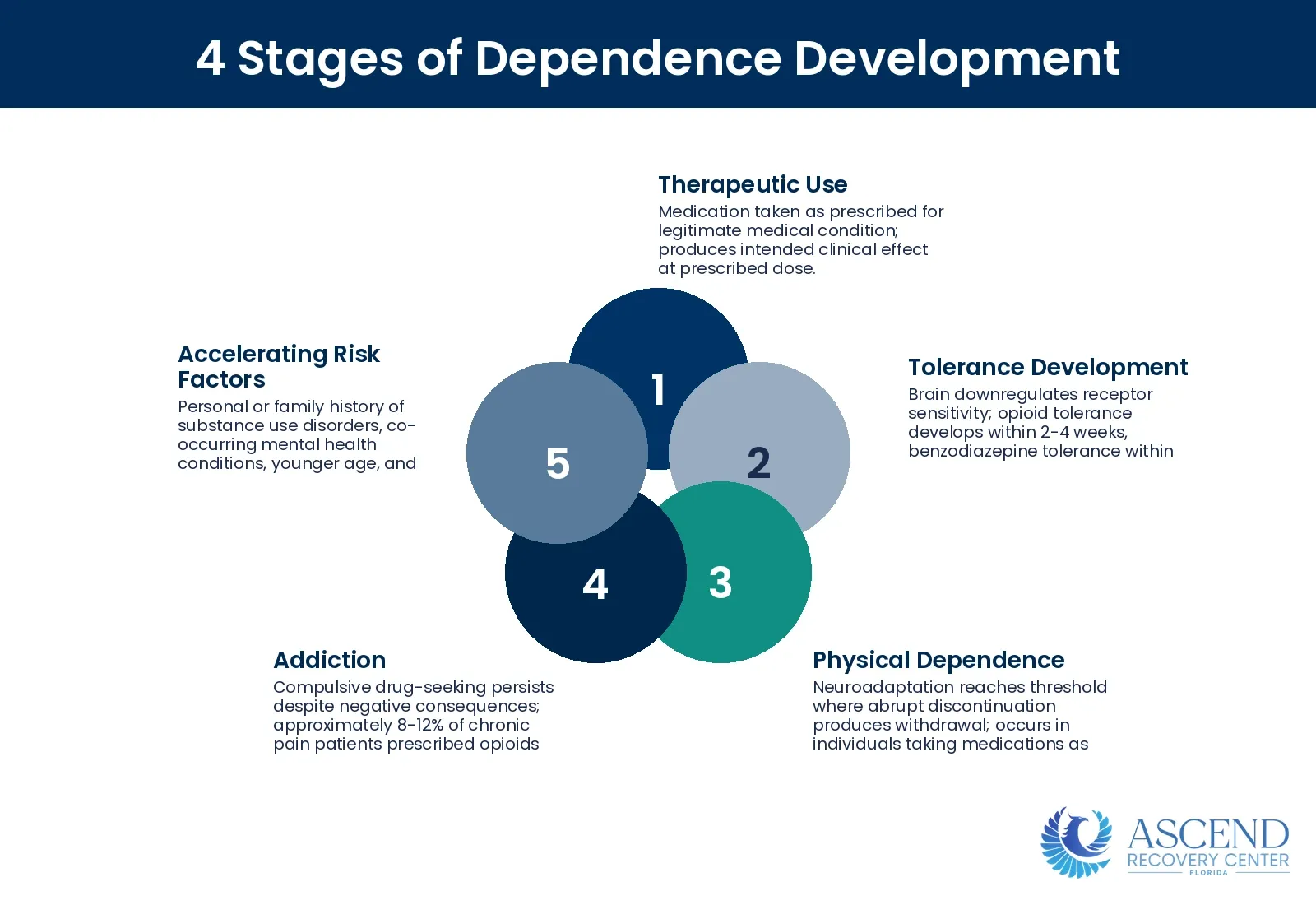
The following are the 4 stages of prescription drug dependence development:
- Therapeutic use — the medication is taken as prescribed for a legitimate medical condition (pain, anxiety, ADHD). The drug produces the intended clinical effect at the prescribed dose.
- Tolerance development — the brain downregulates receptor sensitivity to compensate for chronic drug exposure. The prescribed dose becomes less effective, prompting dose escalation. Opioid tolerance develops within 2-4 weeks of daily use. Benzodiazepine tolerance to sedative effects develops within 1-2 weeks.
- Physical dependence — neuroadaptation reaches a threshold where abrupt discontinuation produces withdrawal symptoms. Physical dependence is a pharmacological phenomenon — not a moral failing — and occurs in individuals taking medications exactly as prescribed.
- Addiction (substance use disorder) — compulsive drug-seeking and drug-taking behavior persists despite negative consequences. Addiction involves loss of control over use, continued use despite harm, and craving. Not all individuals who develop physical dependence progress to addiction — approximately 8-12% of patients prescribed opioids for chronic pain develop opioid use disorder.
Risk factors that accelerate the transition from dependence to addiction include personal or family history of substance use disorders, co-occurring mental health conditions, younger age at first use, and higher prescribed doses.
What Are the Signs of Prescription Drug Addiction?
The signs of prescription drug addiction fall into 4 categories: behavioral changes, physical symptoms, psychological symptoms, and social/functional decline. Prescription drug addiction is difficult to detect in early stages because the individual initially obtained the medication through a legitimate medical prescription.
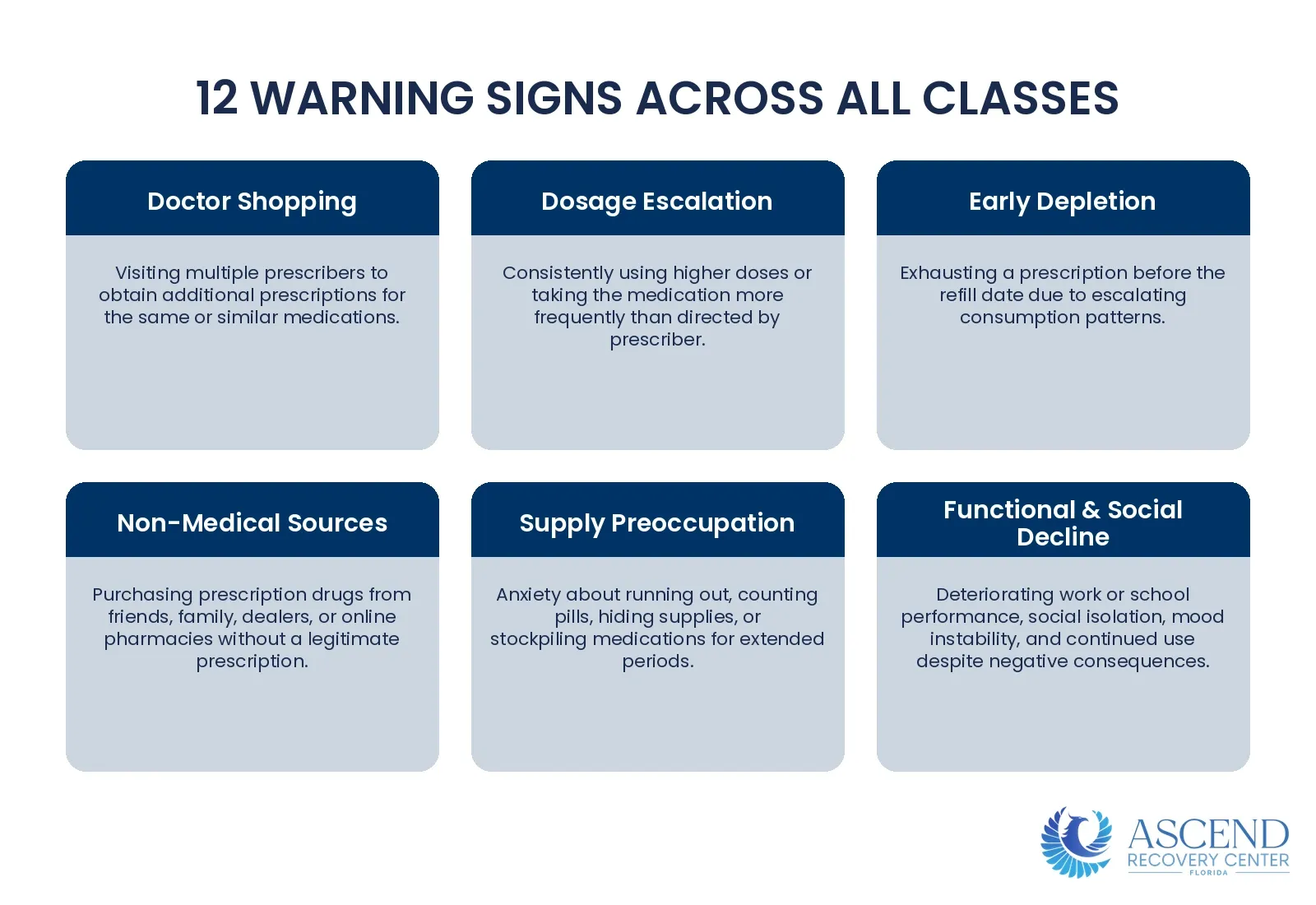
The following are 12 warning signs of prescription drug addiction across all 3 drug classes:
- Doctor shopping — visiting multiple prescribers to obtain additional prescriptions for the same or similar medications
- Taking more than prescribed — consistently using higher doses or taking the medication more frequently than directed
- Running out early — exhausting a prescription before the refill date due to escalating consumption
- Obtaining medications from non-medical sources — purchasing prescription drugs from friends, family members, dealers, or online pharmacies without a prescription
- Preoccupation with medication supply — anxiety about running out, counting pills, hiding supplies, or stockpiling medications
- Withdrawal symptoms between doses — physical discomfort (pain, anxiety, insomnia) that resolves immediately after taking the next dose
- Using the medication for non-prescribed purposes — taking opioids for anxiety, benzodiazepines for sleep without a sleep disorder, or stimulants for weight loss or productivity enhancement
- Functional decline — deteriorating performance at work, school, or home responsibilities
- Social isolation — withdrawing from relationships, hobbies, and activities unrelated to medication use
- Mood instability — irritability, agitation, or emotional flatness that correlates with medication timing
- Physical changes — weight loss or gain, pupil constriction (opioids) or dilation (stimulants), slurred speech (benzodiazepines), excessive sedation, or hyperalertness
- Continued use despite negative consequences — persisting with misuse after experiencing health problems, relationship damage, legal issues, or financial strain
A clinical assessment from a licensed addiction specialist is required for accurate diagnosis. Contact at (561) 956-1082 for a confidential evaluation.
“The misuse of prescription opioids, benzodiazepines, and stimulants represents a significant public health challenge requiring treatment approaches tailored to the pharmacology and risk profile of each drug class.”
How Is Prescription Drug Addiction Treated by Drug Class?
Treatment for prescription drug addiction is determined by the drug class involved — opioids require medication-assisted treatment, benzodiazepines require medically supervised taper, and stimulants require behavioral therapy as the primary intervention. Each drug class has a different withdrawal risk profile, available pharmacotherapies, and treatment timeline.
The following are the treatment protocols for each of the 3 prescription drug classes:
- Prescription opioid addiction (oxycodone, hydrocodone, fentanyl, codeine) — medication-assisted treatment with buprenorphine (Suboxone, Sublocade) or naltrexone (Vivitrol) combined with cognitive-behavioral therapy. MAT reduces opioid overdose deaths by 50% and improves treatment retention by 60%. Medical detox is required before initiating naltrexone. Buprenorphine induction begins within 12-24 hours of the last opioid dose. Ascend Recovery Center coordinates MAT prescribing and monitoring within PHP and IOP treatment tracks. See opiate addiction treatment for detailed opioid-specific treatment information.
- Benzodiazepine addiction (Xanax, Valium, Klonopin, Ativan) — gradual medical taper over 4-12 weeks (or longer for long-term users) is the standard of care. Abrupt benzodiazepine discontinuation is medically dangerous and produces seizures, psychosis, and death in severe cases. Taper protocols reduce the dose by 10-25% every 1-2 weeks. Ascend Recovery Center coordinates medical taper with prescribing physicians and provides concurrent behavioral therapy for anxiety management without benzodiazepines. See benzodiazepine addiction treatment for detailed information.
- Prescription stimulant addiction (Adderall, Ritalin, Vyvanse) — behavioral therapy (CBT, contingency management) is the primary treatment because no FDA-approved medication exists for stimulant use disorder. Stimulant withdrawal produces fatigue, depression, and hypersomnia but does not require medical detox. The behavioral treatment approach for prescription stimulant addiction mirrors the evidence-based framework used in cocaine addiction rehab and treatment. Psychiatric evaluation for underlying ADHD is essential — untreated ADHD drives stimulant misuse relapse. See stimulant addiction treatment for detailed information.

Ascend Recovery Center — Palm Beach Gardens, FL
Does Your Insurance Cover Drug Rehab Education?
Free, confidential verification in under 15 minutes.
How Is Prescription Drug Addiction Treated in PHP and IOP Programs?
PHP and IOP provide structured outpatient treatment for prescription drug addiction with clinical intensity tailored to the specific drug class, addiction severity, and co-occurring conditions. PHP delivers 5-6 hours of programming per day, 5 days per week. IOP delivers 3 hours per day, 3-5 days per week. Both levels of care allow individuals to maintain housing, employment, and family involvement during treatment.
The following are 7 core components of prescription drug addiction treatment at Ascend Recovery Center:
- Drug-class-specific protocol — treatment plans are built around the pharmacological profile of the specific medication involved (opioid MAT coordination, benzodiazepine taper monitoring, or stimulant behavioral intervention)
- Cognitive-behavioral therapy (CBT) — individual and group CBT targeting drug-specific triggers, thought patterns maintaining misuse, and coping skill development for managing pain, anxiety, or attention deficits without prescription drug misuse
- Psychiatric evaluation and medication management — assessment and appropriate pharmacotherapy for the underlying condition the prescription drug was originally treating (chronic pain, anxiety, ADHD), using non-addictive alternatives when clinically indicated
- Trauma-informed therapy — EMDR Therapy and other evidence-based trauma modalities address underlying trauma and PTSD that drive prescription drug misuse
- Group therapy — daily process groups covering relapse prevention, emotional regulation, interpersonal effectiveness, and recovery identity development
- Family education and therapy — structured sessions educating family members about prescription drug dependence versus addiction, supporting medication taper compliance, and rebuilding trust
- Discharge and aftercare planning — coordinated step-down from PHP to IOP to outpatient care, ongoing medication management, mutual-aid meeting referrals, and relapse response protocols
“Patients with prescription drug use disorders benefit from integrated treatment that addresses both the substance use disorder and the underlying medical or psychiatric condition for which the medication was originally prescribed.”
How Is Withdrawal Managed for Each Prescription Drug Class?
Prescription drug withdrawal management varies by drug class — opioid withdrawal requires medical monitoring and possible MAT induction, benzodiazepine withdrawal requires medically supervised taper to prevent seizures, and stimulant withdrawal requires psychological support for depression and fatigue. Ascend Recovery Center does not provide on-site medical detox but coordinates with licensed detoxification facilities for clients requiring medically supervised withdrawal management before transitioning to outpatient care.
The following are the withdrawal profiles for each prescription drug class:
- Prescription opioid withdrawal — symptoms begin 8-24 hours after the last dose (short-acting opioids like oxycodone) or 24-48 hours (long-acting opioids like methadone). Peak intensity occurs at 36-72 hours. Acute withdrawal resolves in 5-10 days. Symptoms include muscle pain, gastrointestinal distress, insomnia, anxiety, and intense cravings. Buprenorphine induction during early withdrawal eliminates symptoms within 30-60 minutes. See the opioid detox timeline for a detailed withdrawal schedule. For broader information on medically supervised withdrawal across all substance classes, see drug and alcohol detoxification and withdrawal management.
- Benzodiazepine withdrawal — symptoms begin 1-4 days after the last dose (short-acting benzodiazepines like alprazolam) or 2-7 days (long-acting benzodiazepines like diazepam). Withdrawal produces anxiety, insomnia, tremors, sensory hypersensitivity, and seizures. Grand mal seizures occur in 20-30% of individuals who abruptly discontinue high-dose benzodiazepines. Medically supervised taper over 4-12 weeks is mandatory. Benzodiazepine withdrawal is potentially fatal without medical management.
- Prescription stimulant withdrawal — symptoms begin within 12-24 hours of the last dose. The crash phase (days 1-5) produces extreme fatigue, hypersomnia, increased appetite, and dysphoria. Extended withdrawal (weeks 1-4) involves persistent fatigue, depression, anhedonia, and difficulty concentrating. Stimulant withdrawal is not medically dangerous but produces suicidal ideation in some individuals requiring psychiatric monitoring.
How Are Co-Occurring Conditions Treated Alongside Prescription Drug Addiction?
Co-occurring mental health and medical conditions are present in 60-80% of individuals with prescription drug addiction, because the original prescribing condition (pain, anxiety, ADHD) persists and requires non-addictive treatment management. The central clinical challenge of prescription drug addiction treatment is managing the legitimate medical or psychiatric condition that initiated the prescription while eliminating the addictive medication from the treatment plan.
The following are 5 co-occurring conditions frequently associated with prescription drug addiction:
- Chronic pain — individuals with prescription opioid addiction require alternative pain management strategies including non-opioid medications (gabapentin, duloxetine, NSAIDs), physical therapy, and mindfulness-based pain management. Buprenorphine provides both addiction treatment and partial pain relief.
- Anxiety disorders — individuals with benzodiazepine addiction require non-benzodiazepine anxiety management including SSRIs/SNRIs, buspirone, CBT for anxiety, and mindfulness-based stress reduction
- ADHD — individuals with prescription stimulant addiction require ADHD assessment to determine whether ADHD medication is clinically necessary. Non-stimulant ADHD medications (atomoxetine, guanfacine, bupropion) provide treatment without addiction risk.
- Depression — depressive disorders co-occur with all 3 classes of prescription drug addiction and require concurrent antidepressant therapy and psychotherapy
- Trauma and PTSD — trauma drives prescription drug misuse as a maladaptive coping mechanism. EMDR Therapy provides evidence-based trauma resolution without reliance on prescription medications.
Ascend Recovery Center provides dual diagnosis treatment that addresses prescription drug addiction and co-occurring conditions within an integrated clinical framework. Psychiatric evaluation identifies appropriate non-addictive medication alternatives for the original prescribing condition.

Ascend Recovery Center — Palm Beach Gardens, FL
Prescription Drug Use Self-Assessment
1 / 11Answer 11 questions based on DSM-5 substance use disorder diagnostic criteria. This provides general guidance — a clinical evaluation determines diagnosis.
Using prescription substances in larger amounts or for longer periods than intended?
Confidential · Not a clinical diagnosis · HIPAA protected